
Buffalo Grove Epoxy Flooring provides concrete floor repair in Buffalo Grove, IL, serving surrounding cities including Prospect Heights, Deerfield, Lake Zurich, Lake Forest and Barrington. In more than 20 years of coating concrete, we have learned that the condition of a slab sets a hard limit on how long any floor system will last, so repair is where every good floor starts.
Before we price a coating, we walk the floor and map every crack, spall, pitted patch and failing joint, along with any old coating that is letting go. Each one gets a repair method and its own line in the proposal. That way you see exactly what your slab needs, rather than a single number that hides the repair work.
Some floors are past repair. When a section has heaved, sunk enough to hold water or broken into loose pieces, we say so and recommend replacement or a fix to the underlying cause before anyone puts a coating over it. A coating applied to a failing slab only outlines the failure.
Cracks and How We Treat Them
Hairline Shrinkage Cracks
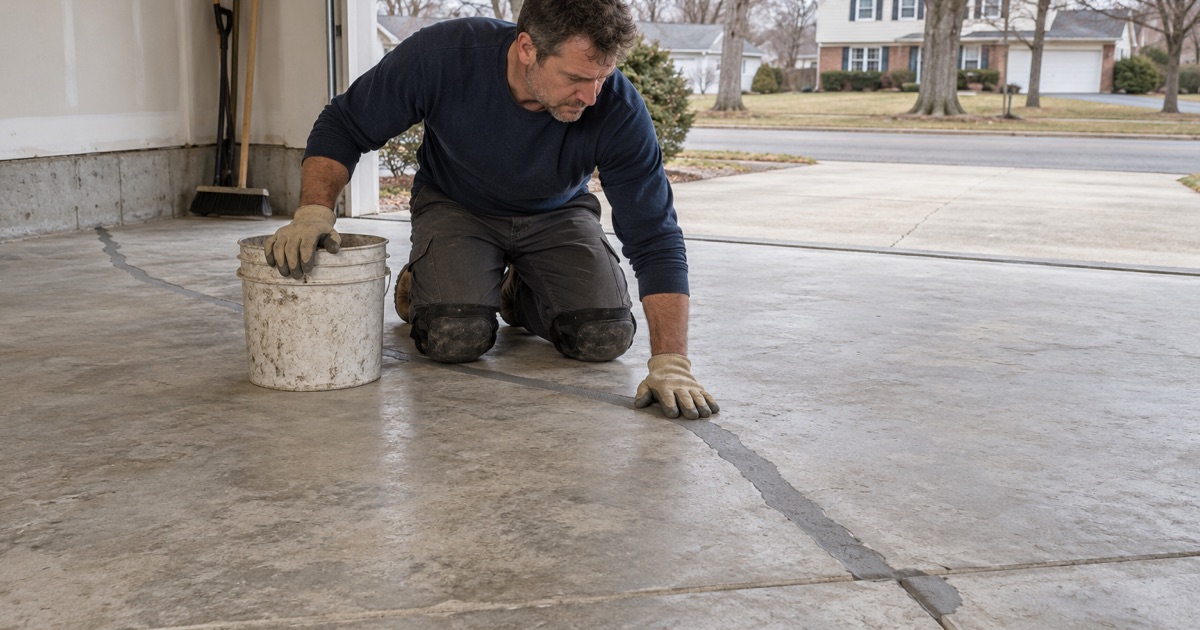
Nearly every slab has thin cracks that formed as the concrete dried and shrank. Most are stable and do not move much. We open them slightly with a crack chaser so the filler can grip, vacuum them clean and fill them flush with a rigid epoxy or polyurea crack filler.
Once ground flat, those repairs vanish under a flake broadcast. They may still show faintly under a solid color, which we tell you before you choose a system.
Wider and Moving Cracks
Wider cracks, or cracks that line up with seasonal movement, need a different approach. A rigid filler can crack again alongside the repair. Depending on the crack, we may use a semi-rigid filler, stitch the crack with reinforcing staples or treat it as a joint that the coating honors rather than bridges.
Where a crack keeps growing, something underneath is still moving. That calls for finding the cause first, and we will not pretend a coating can hold together a slab that is still shifting.
Cracks That Carry Water
In basements, a crack that weeps water or shows mineral staining is a moisture path, not just a cosmetic flaw. Filling it at the surface does not stop water under pressure. That crack needs to be addressed by a waterproofing contractor before we coat the floor, and we test the slab for moisture afterward.
Spalls, Pitting and Salt Damage
Spalled Edges at Doors and Joints
Spalls are pieces of concrete broken away from the surface, often at the edge of a garage door, along control joints or where heavy loads hit the floor. We cut back to sound concrete, clean the area and rebuild it with an epoxy or polymer repair mortar that bonds to the slab.
Rebuilt edges are ground flush with the surrounding floor so the coating runs across them without a bump. At garage doors, we pay attention to the edge where the slab meets the apron, since that area takes the most impact and the most salt.
Salt Scaling and Surface Pitting
Rock salt, calcium chloride and brine ride into garages on tires all winter. As salty water soaks in and freezes, the surface breaks off in thin flakes and leaves a rough, pitted area, usually where cars park and drip. On slabs from the 1970s and 1980s, which make up most of the village’s homes, decades of that leave deep scaling.
We grind away the loose, scaled surface, then fill and skim the pitted area with a repair mortar before coating. Coating over scaling without repairing it leaves a weak layer under the new floor.
Old Patches That Have Failed
Many slabs carry earlier patches that have cracked, debonded or crumbled. A hollow sound when tapped tells us a patch has let go. We remove failed patches completely and replace them, because a new coating over a loose patch will crack along its edges.
Joints, Drains and Transitions
Control Joints
Control joints are the saw cuts or tooled lines in a slab that guide where it cracks. In garages and basements, we usually fill static joints flush before coating so the floor is smooth. In warehouses where forklifts cross joints constantly, a semi-rigid joint filler protects the edges from chipping.
Where a joint is still moving, such as one between two separate pours, we keep it open through the coating and seal it with a flexible sealant. Filling a moving joint rigidly simply moves the crack into the coating.
Drains, Sump Rims and Penetrations
The concrete around floor drains, sump pits and pipe penetrations is often broken or poorly finished. We rebuild those edges so the coating can end in a clean line and water flows to the drain rather than pooling at a lip.
In Buffalo Grove, basement floor drains run through a sump to the sanitary sewer, so we keep repair debris and dust out of every opening and leave covers and cleanouts accessible.
Thresholds and Floor Transitions
Where a coated floor meets carpet, tile, a door threshold or an apron outside, we cut a clean termination and repair the edge so the coating does not end on a crumbling lip. That edge is where a floor typically starts to peel if it is left unprepared.
Repairs on Commercial Floors
Warehouse and Shop Slabs
In the business parks around Busch Parkway, Johnson Drive and Aptakisic Road, older floors carry worn joints, forklift damage and oil-soaked concrete. We repair joint edges, cut out contaminated areas and patch them, and schedule the work in sections so the business can keep operating around it.
Repairs Before Polishing
On a floor that will be polished rather than coated, repairs stay visible in the finished surface. We choose patch materials and colors that blend as closely as possible and discuss with you how the repaired areas will look once the polish is done.
- 20+ Years in Business
- Moisture Test in Every Scope
- Diamond-Ground, Never Acid-Etched