
Buffalo Grove Epoxy Flooring handles concrete grinding in Buffalo Grove, IL, serving surrounding cities including Prospect Heights, Deerfield, Lake Zurich, Lake Forest and Barrington. Grinding is the first real step in every floor we coat or polish, and after more than 20 years of slab work we treat it as the step that decides whether the rest of the floor lasts.
A coating bonds to whatever surface it touches. If that surface is old sealer, soft cement paste, oil-soaked concrete or the residue an acid etch leaves behind, the coating is only as strong as that layer. Grinding cuts down to sound, open concrete and leaves a texture the new system can lock into.
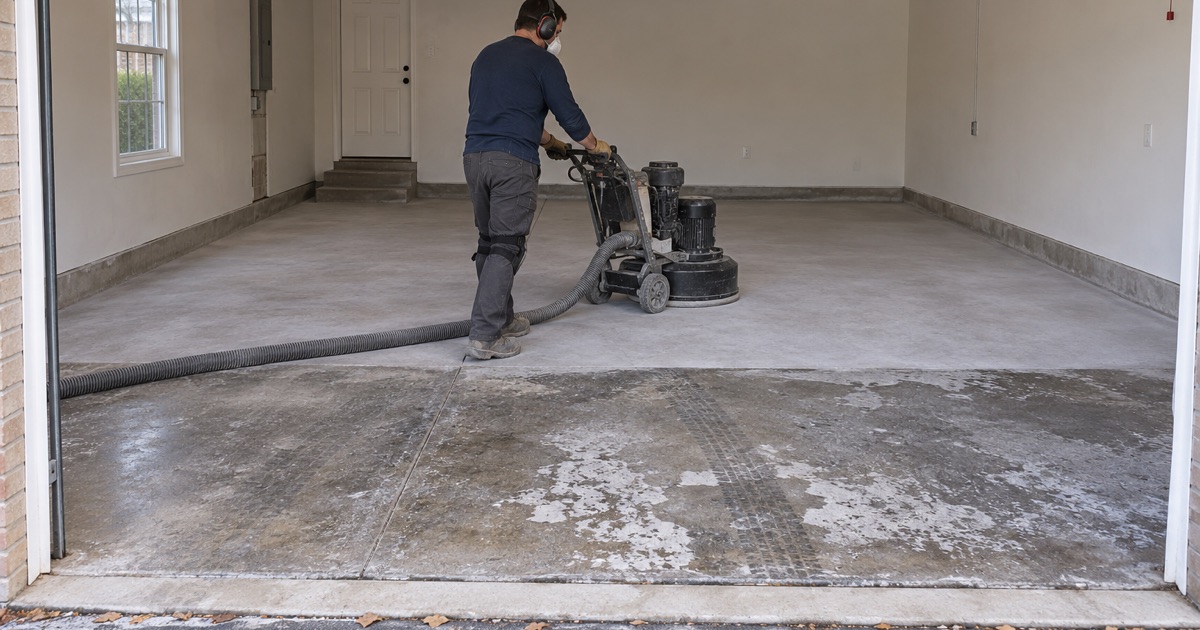
We grind with diamond tooling on planetary and walk-behind machines, and use shot blasting where a large, clean slab suits it. Every machine runs connected to an industrial vacuum, so the dust is collected at the tool rather than swept into the air or rinsed toward a floor drain, a sump or a storm inlet.
What Concrete Grinding Removes
Old Coatings, Paint and Sealers
Many garage and basement floors in the village carry one or more layers of floor paint, a clear sealer or an earlier epoxy. Those layers have to come off before a new system goes down, because the new coating can only be as well bonded as the layer under it.
We use tooling chosen for the specific coating. Thin paint and sealer come off quickly with standard diamonds, while thick or rubbery coatings may call for a scraper or more aggressive tooling first.
Tile Adhesive and Carpet Residue
Basements and commercial rooms that once had tile or carpet often hold black mastic, thinset or pad glue. Adhesive left on the slab is a weak layer and can bleed through a coating. Older black mastic may contain asbestos, so we test it before grinding and plan removal accordingly.
Laitance and Weak Surface Paste
The top layer of many slabs is a thin, weak paste called laitance, made of fine particles that rose to the surface while the concrete was finished. It looks solid but can flake away under a coating. Grinding removes it and exposes the stronger concrete beneath.
Laitance is common on slabs that were troweled hard or finished while bleed water was still on the surface. A simple scratch test often shows it, and a slab that dusts heavily when swept usually has it. We plan enough grinding passes to get below it everywhere, not just in the spots that look worst.
Surface Profile and Why It Is Measured
The ICRI CSP Scale
The International Concrete Repair Institute publishes a set of concrete surface profiles, numbered CSP 1 to CSP 10, from nearly smooth to very rough. Coating makers state which profile their products need, and thin coatings generally call for a finer profile than thick mortars.
We grind to the profile the selected product calls for and compare the result against reference chips. That turns preparation into something you can check, rather than a word in a proposal.
Grinding Versus Shot Blasting
Diamond grinding cuts the surface with abrasive segments, works well at edges and on floors carrying coatings, and leaves a flatter finish. Shot blasting throws steel shot at the slab and leaves a more open, textured profile across large clean areas.
Many jobs use both: shot blasting across the main floor and grinders along walls, corners and around drains. The choice depends on the slab, the coating and how much profile is needed.
Why We Never Acid Etch
Acid etching is cheap and common in do-it-yourself kits, but it gives an uneven profile, barely affects sealed or contaminated concrete and leaves residue that has to be rinsed away. We open every slab mechanically so the profile is consistent and the floor stays dry.
Grinding Garage, Basement and Commercial Slabs
Garage Slabs and Road Salt
Garage slabs near the overhead door often show scaling from rock salt and brine tracked in through the winter. Grinding removes the loose, scaled surface and reveals how deep the damage goes, so pits can be filled before coating.
Most homes in the village date from the 1970s and 1980s, so many garage slabs have decades of winters, oil drips and patching behind them. Grinding is when the floor’s real condition becomes clear, and when we decide with you whether it should be repaired and coated or whether a damaged section needs replacing first.
Basement Floors and Moisture
Grinding a basement slab also shows us where water has been. Efflorescence, stained cracks and soft areas become clear once the surface paste is gone. We pair grinding with a written moisture test, because a perfectly prepared slab can still lift a coating if vapor drive is high.
Basement grinding also works around the sump pit, floor drain and any ejector pit. We cover and protect each opening so dust and chips never reach a pump, and grind the slab edges at the rims by hand tool so the coating can end in a clean, sealed line.
Warehouse and Shop Floors
In the business parks around Busch Parkway, Johnson Drive and Aptakisic Road, older warehouse and shop floors carry oil stains, old line paint and worn joints. We grind joint edges flat, remove contaminated surface concrete and prepare the floor for coating or polishing in phases around the business’s operating hours.
Oil that has soaked deep into a shop floor may not grind out completely. In those spots we grind, clean and test whether the coating will bond, and where it will not, the contaminated concrete is cut out and patched rather than coated over and left to fail.
Dust Control and Clean Work
Capture at the Machine
Concrete dust contains fine silica. Every grinder we use is shrouded and connected to a vacuum with filtration made for that dust, so it is captured as it is made. We do not dry sweep or wash slurry into drains.
Keeping slurry and dust out of drains matters here because basement floor drains in Buffalo Grove run through a sump to the sanitary sewer, and outdoor inlets lead toward local waterways. Dry capture keeps both clean and leaves the floor ready for testing the same day.
Protecting the Rest of the Building
In an attached garage or an occupied office, we seal doorways, protect equipment and run the vacuum during and after grinding. The ground floor is vacuumed again right before any primer goes down, since dust left on the surface weakens the bond.
- 20+ Years in Business
- Moisture Test in Every Scope
- Diamond-Ground, Never Acid-Etched