
Buffalo Grove Epoxy Flooring grinds and finishes polished concrete floors in Buffalo Grove, IL, serving surrounding cities including Prospect Heights, Deerfield, Lake Zurich, Lake Forest and Barrington. We have been working on concrete for more than 20 years, and polishing is the service where the slab itself becomes the finished floor, so what we learn about it first matters more than anywhere else.
A polished floor has no coating to hide behind. Every crack, old patch and adhesive stain stays visible in the final surface. That is why we look closely at the slab, grind a test patch and talk through what the concrete will look like before we put a price on the work.
Our proposals list the grit sequence, the densifier, any guard, and the sheen level, along with repair lines for cracks and joints. Grinding dust is collected at the machine by a vacuum rather than washed toward a floor drain, which keeps occupied buildings and storm inlets clean.
How Polished Concrete Floors Are Made
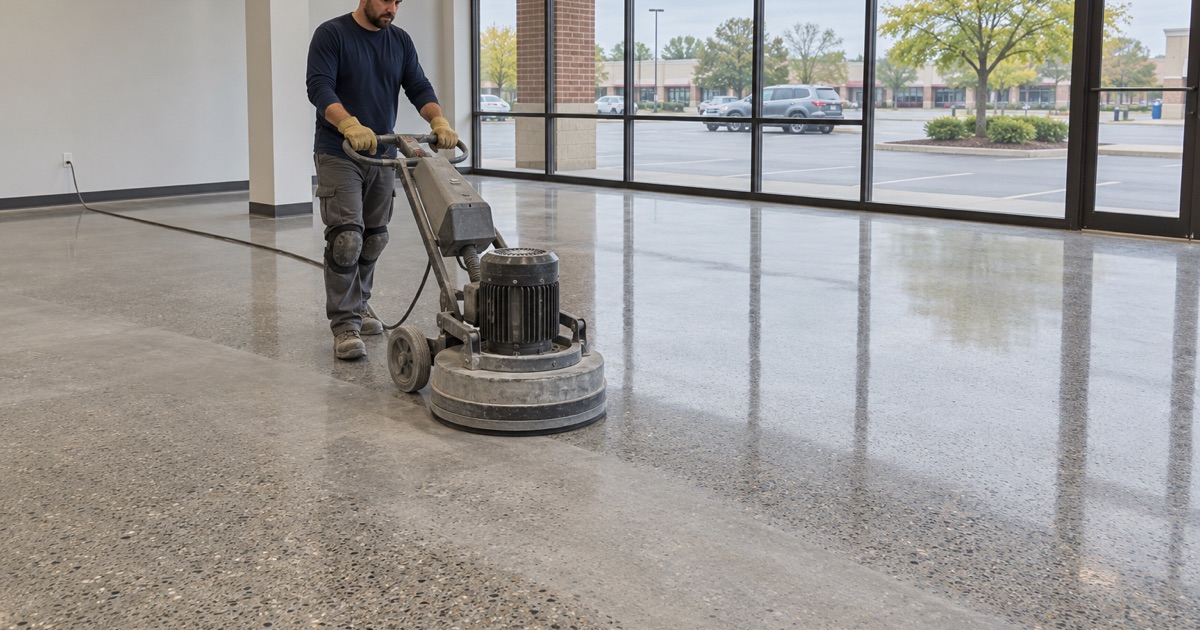
Grinding Flat With Metal-Bond Diamonds
Polishing begins with coarse metal-bond diamonds that cut the slab flat and remove old sealers, adhesives and surface paste. How long we stay at this stage decides how much of the stone in the concrete shows. A light pass keeps a smooth cream finish, and a deeper cut exposes salt-and-pepper fines or larger aggregate.
This is also when the slab tells us about itself. Soft spots, hollow areas, old patches and cracks appear as the surface paste comes off. We note each one, fill or repair the ones that need it, and show you the test area before moving to the finer steps.
Densifying With Lithium Silicate
After the coarse grinding, we apply a lithium silicate densifier. It reacts with the free lime in the concrete to harden the surface, which helps it take a polish, resist abrasion and shed dust instead of powdering under foot traffic.
The densifier goes on at a stage where the surface is open enough to absorb it, then the grinding continues. Timing it correctly matters: too early and much of it is ground away, too late and the surface is too closed to take it in.
Honing and Polishing to a Chosen Sheen
Resin-bond diamonds then refine the scratches left by each earlier step. The finer the final grit, the higher the reflectivity. A honed matte finish suits many warehouses and garages, while satin and high gloss are common in lobbies, showrooms and living spaces.
We agree on the sheen in writing before we start. Higher gloss looks striking but shows scuffs and dust more readily, and in wet areas a lower sheen is usually the better choice for footing.
Commercial Polished Concrete Floors
Warehouses and Flex Space in the Business Parks
Buffalo Grove’s industrial buildings sit largely in its business parks: Corporate Grove off Busch Parkway, Chevy Chase Business Park along Johnson Drive and Aptakisic Creek Corporate Park at Aptakisic Road and Industrial Drive. Many of those bays are big slabs under forklifts, where polished concrete appeals because there is no coating to chip or peel.
The weak points in a warehouse floor are the joints and the patched areas, not the polish itself. We fill joints with a semi-rigid filler where forklift wheels cross them, and repair spalled joint edges before polishing so the wheels do not keep breaking them down.
Retail, Showroom and Office Lobbies
Stores along Lake Cook Road and Route 83, and office lobbies across the corporate parks, use polished concrete for its clean look and low upkeep. In those spaces we usually aim for a satin to high-gloss finish and a guard that resists everyday spills.
Because these spaces rarely close for long, we phase the work by area and run overnight or weekend shifts when a business has to stay open during the day. The vacuum attached to each grinder keeps dust out of merchandise and air handling.
Where Polish Is the Wrong Choice
Some commercial rooms need a coating instead. Commercial kitchens, labs that handle acids, and rooms that stay wet do better with a seamless resin system, because a polished surface can etch, stain or become slick under those conditions. We tell you when another system fits the room better.
The same goes for floors that will be covered by racking, machine bases or heavy fixtures across most of their area. Paying for a high polish under shelving rarely makes sense, and a densified, honed finish or a hard-wearing coating may give the owner more value for the same budget.
Residential Polished Concrete Floors
Basements and Lower Levels
On the Cook side of the village, most houses have a full or partial basement, and polished concrete can turn that slab into a finished floor without adding a covering. Unlike a coating, a polished floor does not form a film that trapped moisture can lift, but damp slabs can still show efflorescence and staining.
We read a basement slab for past water before we polish it. A basement that still takes on water needs that problem fixed first, because polishing does nothing to stop seepage and a wet slab will mark the finish.
Garages and Workshops
A polished garage floor is easy to sweep and has no coating for a hot tire to lift. Its weakness is staining: oil, brake fluid and road salt residue can mark it, so we apply a penetrating guard and explain how to clean the floor through a salty winter.
If you want maximum stain resistance and color, a coated garage floor is usually the better pick. We explain both, and the choice depends on how you use the space and how much patina you are willing to accept.
Main Living Areas and New Additions
In an addition or a new slab, polished concrete can be planned before the pour, which gives the best result. Existing slabs in living areas often carry carpet tack holes, tile adhesive and old patches that will show, so we grind a sample and let you decide whether that character suits the room.
In finished living spaces we also plan the dust and noise. Grinding is loud, so we schedule around the household, protect cabinets and baseboards, and run the vacuum at every grinder so the fine powder does not drift through the rest of the house.
What Shapes the Cost of a Polished Floor
Slab Condition and Repairs
The biggest variable is the slab we start with. Removing carpet adhesive, thinset or an old coating adds grinding passes, and every crack, spall and joint that needs filling adds its own line. A clean, sound slab that was never covered polishes faster than one carrying decades of floor coverings.
We map those conditions during the estimate and show them in the proposal, so the price reflects your floor rather than a per-square-foot number pulled from a chart. Two floors of the same size can differ widely once those lines are added up.
Aggregate Exposure and Final Sheen
The deeper we grind to expose stone, and the higher the final gloss, the more passes the floor needs. A cream finish at a honed sheen is the quickest option, while a full aggregate exposure taken to high gloss is the most involved. The proposal names the exposure level and the final grit so the comparison between options is clear.
Caring for a Polished Floor
Daily and Weekly Cleaning
Grit tracked in from outside is what wears a polish. A walk-off mat at each entry and regular dust mopping do most of the work. Wet cleaning with a neutral cleaner keeps the surface bright without the dulling film harsh chemicals can leave.
In winter, rock salt and calcium chloride residue tracked in from parking lots and driveways leave a white film on polished concrete. Picking it up promptly with a neutral cleaner or a dedicated salt-residue product keeps it from dulling the finish near the doors.
Burnishing and Restoring the Sheen
Busy floors lose some of their shine in traffic lanes over time. A periodic burnish with a high-speed machine and the right pad restores much of it, and a floor that has dulled badly can be re-honed with fine diamonds rather than starting over.
For commercial owners we can suggest a maintenance interval based on traffic, from a quick burnish in a lobby to a reapplied guard in a busy retail aisle. A polished floor that is looked after keeps its sheen for years without the stripping and recoating that waxed floors need.
- 20+ Years in Business
- Moisture Test in Every Scope
- Diamond-Ground, Never Acid-Etched