
Buffalo Grove Epoxy Flooring builds industrial epoxy flooring in Buffalo Grove, IL, serving surrounding cities including Prospect Heights, Deerfield, Lake Zurich, Lake Forest and Barrington. Industrial floors take the heaviest punishment we see, from loaded forklifts and pallet jacks to dropped steel, hydraulic oil and harsh cleaners, and in more than 20 years we have learned that they fail at the details: joints, edges, thin spots and poor bond.
That is why every industrial job starts with the slab. We shot blast or diamond grind it to the profile the system needs, test it for moisture, and map cracks, worn joints, oil-soaked areas and old coatings. The proposal sets out the product line, number of coats and finished thickness for each area of the building, because a plant floor is rarely one floor.
We also plan around production. Industrial spaces are phased by bay or aisle, with overnight and weekend shifts where a line cannot stop, and dust is captured at every machine so it never reaches equipment, stock or a floor drain.
Building a Floor for Industrial Loads
Thickness Matched to Traffic
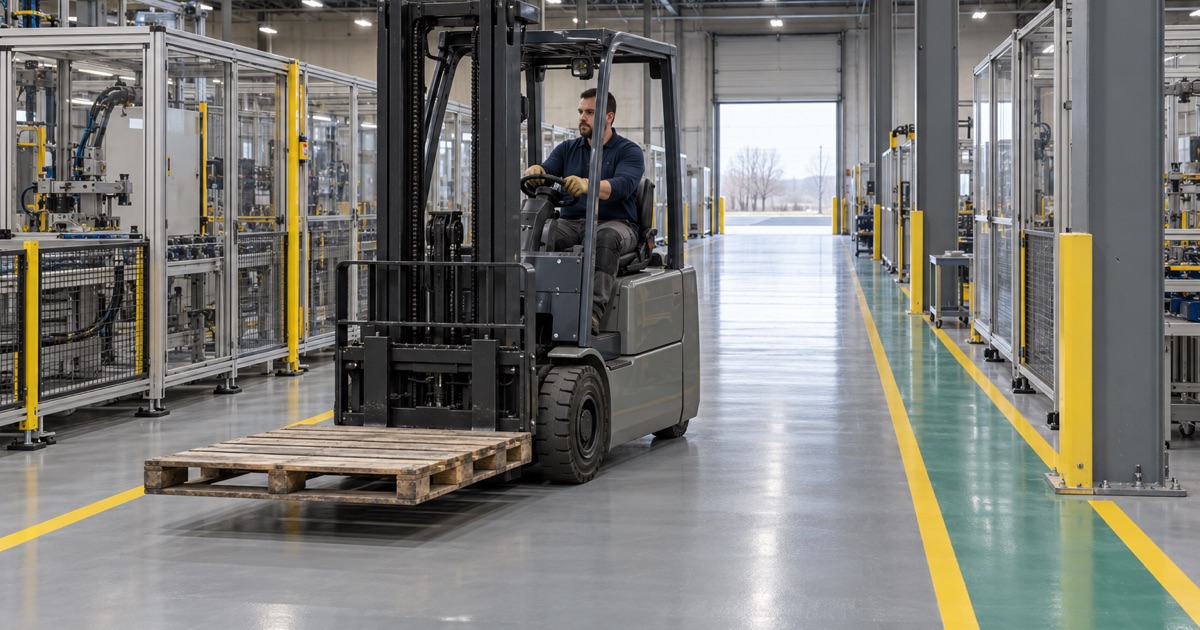
Industrial floors are specified by what drives over them. Rubber-tired forklifts, pallet jacks with polyurethane wheels and steel-wheeled carts each wear a coating differently. Light storage areas can take a thinner film, while main aisles, loading zones and work cells need much thicker systems.
We set thickness by area and name it in the proposal. A floor that is the same thin coat everywhere wears through first in the places that matter most, while a floor built thicker in the heavy lanes lasts far longer for a similar budget.
Broadcast and Trowel-Applied Systems
For heavy traffic, we often build floors with multiple layers of epoxy and quartz aggregate broadcast, or a trowel-applied epoxy mortar for the most demanding areas. Each layer adds thickness and impact resistance, and the broadcast sets the slip texture.
Trowel-applied mortars also level uneven slabs and rebuild worn surfaces at the same time, which helps in older buildings where the floor has been patched many times. The proposal marks which areas get mortar and which get a broadcast build.
Impact and Dropped Loads
Work cells, maintenance shops and receiving areas see dropped parts and tools. Thin coatings chip under impact, exposing concrete that then wears quickly. A thicker, aggregate-filled system spreads that impact and resists chipping, and damaged spots can be patched in without redoing the whole floor.
Joints, Edges and Transitions
Control Joints Under Forklift Traffic
The joints in a warehouse slab are the most common place for an industrial floor to fail. Forklift wheels hitting an open joint break its edges, and that damage spreads into the coating. We rebuild broken joint edges, then fill joints with a semi-rigid filler that supports the wheels while allowing some movement.
Where joints are still moving, such as construction or expansion joints, we keep them open through the coating and seal them so the floor can move without cracking. Those sealed joints are a maintenance item, and we show your crew how to check them.
Dock Plates, Doorways and Trench Drains
Dock levelers, overhead door thresholds and trench drains are where coatings take the most abuse. We cut the coating into the concrete at those edges rather than feathering it out to nothing, which prevents the edge from catching wheels and peeling back over time.
Drain bodies, floor plates and equipment anchors stay accessible. We terminate around them cleanly and keep debris and grinding dust out of drains.
Damaged and Oil-Soaked Concrete
Older plants and shops often have areas soaked with hydraulic oil, cutting fluid or fuel. Oil that has penetrated deep into concrete can prevent a coating from bonding. We grind and clean those areas and test them, and where the oil is too deep, we cut out the contaminated concrete and patch it before coating.
Chemical Resistance and Cleaning
Matching the System to What Gets Spilled
Industrial floors are exposed to oils, coolants, fuels, solvents, acids and strong cleaners. Standard epoxy handles many of those, but not all. We ask for a list of every chemical in use, including the products the cleaning crew uses, and choose base and topcoats rated for them.
For aggressive chemicals, a novolac epoxy topcoat or another specialty product may be needed. Where hot water and thermal shock are constant, urethane cement often outperforms epoxy, and we recommend it rather than forcing an epoxy into the wrong room.
Safety Lines and Floor Markings
Aisle lines, pedestrian walkways, forklift zones and hazard markings can be laid out in a contrasting color and built into the system before the final topcoat. Markings installed that way wear with the floor rather than flaking off like painted lines, and they can be planned with your safety team.
VOC Limits on Industrial Coatings
Illinois limits volatile organic content in industrial maintenance coatings to 340 grams per liter and in floor coatings to 250, under 35 Ill. Adm. Code Part 223 Subpart C. Cook and Lake counties both sit in the Chicago ozone nonattainment area, and the limits bind the applicator, so we choose compliant products for every industrial job.
Industrial Floors in Buffalo Grove
Business Parks and Light Manufacturing
Buffalo Grove’s industrial base sits largely in its business parks. Corporate Grove covers about 200 acres off Busch Parkway, Chevy Chase Business Park runs along Johnson Drive, and Aptakisic Creek Corporate Park sits at Aptakisic Road and Industrial Drive. The village’s principal employers include precision manufacturing, distribution and building-products firms.
Many of those buildings date from the 1980s and later, with slabs that have carried decades of forklift traffic, patching and tenant changes. We evaluate each one on its own and tell owners when a section of slab needs repair before any coating will last.
Phasing Around Production
Plants and warehouses rarely shut down for a floor. We work bay by bay, move racking and equipment in planned stages, and schedule work for nights, weekends and planned shutdowns. Each phase has a written return-to-service time for both foot and forklift traffic.
- 20+ Years in Business
- Moisture Test in Every Scope
- Diamond-Ground, Never Acid-Etched